Showing posts with label Ludwig Wittgenstein. Show all posts

Tuesday, 3 May 2011

Wittgenstein Family


In this, the last post in the series on philosopher Ludwig Wittgenstein and his siblings, I shall write about how it ended for the Wittgenstein siblings.

Paul Wittgenstein's life in America

As a person, Paul Wittgenstein, according to his friends, was charming, energetic, and erudite; however, he was also very short-tempered, and despite having many admirable qualities, was not an easy person to get on with. He was aware of these foibles in his character, and chose to lead solitary existence. For example, he never ever stayed in other people’s houses, even those of his close friends; and insisted on booking himself (and his valet) into a nearby hotel whenever he was visiting his friends. 

One of his pupils—after Paul had immigrated to America and was teaching students—remembered that Paul had ‘a shell around him, like a suit of armour that did not permit him to interact with other people’. 

Paul's three children  mostly grew up in America—his son was born in America while his two daughters were very young when they went to America. The children did not meet, during their early years, anyone of Paul’s family.  Much later the children called that their father rarely, if ever, spoke about his illustrious family. 

One of his closest friends wrote shortly after Paul’s death: 

‘Paul’s personality is unforgettable. Those who met him felt it instantly; frequently the impression warded off contact. Highly sensitive to his physical disability, he made self-contained independence his rule of life and met tragedy with fortitude. For those whom he admitted to his friendship, he was the staunchest of friends.’

Paul Wittgenstein married Hilde, his 'Aryan Mistress', in America, and in 1941 their son (also named Paul) was born. Despite the great difference in their age the marriage of Paul and Hilde, for all outward appearances, was successful one. In 1946 he and his family were accorded full American citizenship. 

In the 1950s—by this time he was in his sixties—Paul lived a life of semi-retirement, and published three books of piano music for the left hand. 

Paul's children later remembered him as ‘a stern, incomprehensible, and a somewhat distant and imposing figure’ who was exceptionally enthusiastic about Christmas. 

All of Paul's children spoke English at home and could not understand when their parents spoke to each other in German. 

Paul very rarely spoke about Ludwig Wittgenstein or any of his family to his children. 

Paul and Ludwig, who were very close to each other in their childhood and young adult years, severed all contacts with each other in the last thirteen years, until Ludwig’s death. In 1949 Ludwig Wittgenstein was in America on a visit. On an impulse he went to Paul’s house on Long Island. He found the house empty except for a maid, and left without living a note. 

On the occasions when Paul visited his friend Marga Denke in England, she attempted to reconcile the two brothers by inviting Ludwig, invitations which he declined. 

In 1953 (by this time Ludwig Wittgenstein was dead for two years) Paul wrote to a common friend:

 ‘I kept out of contact with my brother from 1939; he wrote me one or two letters when I was visiting England, in response to Ms Denke’s invitation; I did not answer them. I do not know whether I would have done anything if I had been aware that he was terminally ill.’


Death of Hermine Wittgenstein


                                         (Hermine as a young woman)

Hermine Wittgenstein died in Vienna, in Palais Wittgenstein which was her home for all of her 76 years, in 1950, after a long battle with cancer. 

Hermine (pronounced Hermeena) was the eldest of the Wittgenstein children and remained unmarried until her death. 

Named after her grandfather, Herman, Hermine was her father's favourite. Karl Wittgenstein whose business fortunes changed for the better after Hermine's birth considered her to be his lucky mascot.

Hermine was an introspective person of nervous temperament. Like one of her brothers, Konrad (Kurt), she was markedly ill at ease in the company of strangers. Her nervousness frequently took the form of aloof, abrupt and outwardly arrogant demeanour. According to one family story, when composer Brahms visited the family, Hermine became so wound up with nervous tension that she had to leave the room. She spent most of the evening in another room, vomiting.

Like many of her siblings Hermine was a talented pianist and could also sing very well. But her main hobbies were painting and drawing. In the 1890s, when her father bought the Winter Palais in Vienna, Hermine helped her father collect his formidable art collection. Karl Wittgenstein used to jokingly refer to Hermine as his art director.

In her later years Hermine wrote a memoir of the Wittgenstein family (which was privately circulated amongst the family members) in which (as mentioned in previous posts) she wrote lovingly of many members of the extended family. She devoted a whole chapter to Ludwig Wittgenstein, 'the most worthwhile' of her brothers. She also left behind a loving account of Hans,  who had disappeared in 1902. Konrad (Kurt) Wittgenstein, who killed himself on the battlefields of the First World War, was dispatched in one paragraph. The remaining two brothers, Rudi (who had also killed himself, probably over his sexuality) and Paul (who was alive at the time but was estranged from the family) were not mentioned at all.


                                        (Hermine in her old age)

In 1949, Paul Wittgenstein, who had stayed away from Vienna for more than eleven years, was invited to play in two concerts. Hermine, with whom his only correspondence in the preceding years was through lawyers, lay dying in Palais Wittgenstein. Ludwig Wittgenstein wrote to Marga Denke (Paul’s friend) to inform Paul that Hermine was dying. Paul spent more than a week in Vienna, but did not visit his ailing sister. 

Hermine Wittgenstein died on 11 February 1950. Her most favourite brother, Ludwig, himself diagnosed with terminal prostate cancer, was in Vienna at the time. Ludwig visited Hermine every day for two months until her death; however, she was not in a fit enough state to even recognise him. 'A great loss for me and for all of us,' Ludwig Wittgenstein wrote after Hermine's death. 'Greater than I would have thought.'

The once magnificent Palais Wittgenstein (it was in the Russian sector at the end of the war), the family home of the Wittgensteins for two generations, was razed and demolished by developers after her death.


(The Wittgenstein Winter Palais which Karl Wittgenstein bought in 1890 was an imposing structure that stretched for 50 yards along Alleegasse. It had nine bays on the first floor, seven below, with high arches at either end. In the forecourt was a colossal fountain statue. The hall was somewhat gloomy with high ceiling and mosaic floor, carved panelling and frescoes depicting scenes from Shakespeare's Midsummer Night's Dream.  The most splendid saloon on the first floor was Musiksaal where most of the private concerts were held. These musical soirees were, as Hermine Wittgenstein recalled later, grand, festive occasions.)


                               (The front staircase in Palais Wittgenstein)

Death of Ludwig Wittgenstein

                                     (Ludwig Wittgenstein as a baby)
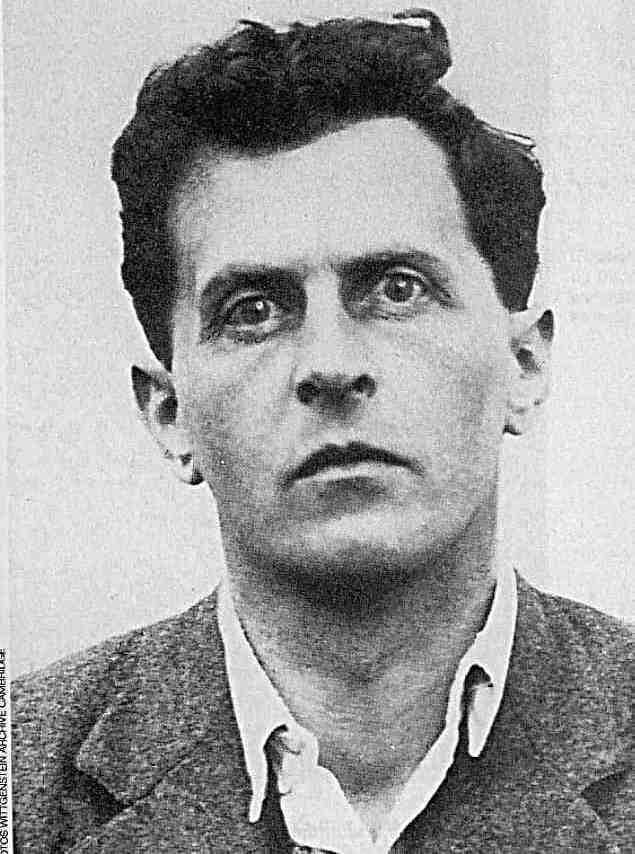
                                                   
                                            (As a young man)

                                       
                                     (On his death bed)

Ludwig Wittgenstein died of prostate cancer in Cambridge on 30 April 1951, three days after his 62nd birthday. 

Four years before his death, in 1947, Ludwig resigned his professorship in Cambridge, and, from then onwards, led a peripatetic existence that took him to Ireland (Dublin), New York (where he tried to meet his estranged brother, Paul), London, Vienna, and Norway. 

It was Cambridge, however, where Ludwig returned to die, in November 1950. He moved into Storey's End, at 76 Storey's Way, the house of his doctor, Edward Bevan. By this time Ludwig knew that he had only a few months left to live. He did not want to die in a  hospital, and Dr. Bevan agreed for him (Ludwig) to move into his (Bevan's) house.

In January 1951 Ludwig made a new will. Having donated his vast share of the Wittgenstein fortune years ago to his siblings and charities, he did not have much in the way of material wealth. In the will he named his literary executor. In the same month he wrote to a friend:

'My mind is completely dead. This isn't a complaint, for I don't really suffer from it. I know that life must have an end and mental life can cease before the rest does.'

Nevertheless in the last two months of his life Ludwig began work on his final manuscripts. (These would be published posthumously as Remarks on Colour and On Certainty.)

On 26 April 1951 Ludwig celebrated his 62nd birthday. He had three more days to live.

The morning after his birthday Ludwig composed his last philosophical thought:

“Someone who is dreaming says ‘I am dreaming,’ even if he speaks audibly in doing so, is no more right than if he said in his dream ‘it is raining,’ while it was in fact raining. Even if his dream were actually connected with the noise of rain.’

That afternoon Ludwig went for a walk. In the evening his condition deteriorated. Dr. Bevan told him that he might have only a few days to live. His response was: 'Good!'

Dr. Bevan's wife, Joan, stayed with Ludwig through the night. On 28 April Ludwig went into a coma from which he did not wake up. His last words, just before he lost consciousness were: 'Tell them, I've had a wonderful life.'

Ludwig Wittgenstein died on 30 April 1951. Four of his former Cambridge students were at his bedside when he died. Two of them were Catholics. None of them was sure what kind of funeral Ludwig would have wanted. Some of them remembered that he had once said that he hoped that his Catholic friends would pray for him. 

Ludwig was given a Roman Catholic burial at St Gile's Church, Cambridge. (One of the Catholic students admitted years later that he had been troubled ever since whether it was the right thing to do.) 

None of Ludwig's family or friends from Vienna was with him when he died.


(The plaque outside 76 Storey Way, the house in which Ludwig Wittgenstein died.)


Death of Helen Wittgenstein


Helene Wittgenstein died of cancer in 1956. Known in the family by the nickname Lenka, Helene would appear to have been the most low profile of the Wittgenstein siblings. 

Plump, plain, and always smiling, Helene was known to be of placid temperament. 

Helene was married to Max Salzer, who belonged to a high-ranking Protestant family in Vienna. Salzer, who, at one time, held a high-ranking position in the Austrian government’s finance department, was chosen by the Wittgenstein family to manage their finances, a job he did with distinction for many years, before he became senile and demented. 

With her children, though, the otherwise placid Helene was exceedingly strict. 

Helene and Max had four children. 

The eldest, a daughter named Maria, died of cancer in the 1940s, while Friedrich, her eldest son, died at the age of 21 because of paralysis caused by polio. 

Helene's second son Felix went on to become a distinguished musicologist; however, he became estranged from the family at an early age and did not keep in touch. 

The youngest daughter was named Clara, whose husband (Arvid Sjogren) was involved (and arrested) in the business of obtaining fake Yugoslavian passports for the family, in 1938. 

Helene became estranged from Paul (like her other siblings) around the time of the dissolution of the family’s trust in Switzerland, although she was not directly involved in the negotiations. 

At the time of her death, Helene had not seen Paul for eighteen years.

Death of Gretl Wittgenstein


(The above portrait of Gretl Wittgenstein was painted by Gustav Kilmt in 1904. Gretl loathed the painting and believed that her mouth was inaccurately depicted by Kilmt. Years later she had it repainted by a relatively unknown artist. In the painting Gretl appears self conscious in a fancy shoulderless gown that appears ill-fitting.)

Gretl outlived Helene by a couple of unhappy years. A strong minded and energetic person—according to Hermine Gretl was the only one amongst her siblings who at times showed the energy and initiative of their father—she lived the high-flying lifestyle of the rich in the 1920s and 1930s, and, in her own way tried to save the family from the clutches of the Nazis during the war years, with some success. 

In her younger years Gretl was closest to Rudi. She was devastated when Rudi killed himself in a dramatic manner in Berlin. She married within months of Rudi's suicide. By that time, Karl Wittgenstein, the children's father, furious at the shame brought upon the family by Rudi, had forbidden the family members to even utter his dead son's name in his presence. As Gretl came out of the church after the marriage ceremony she asked one of her friends to secretly put a wreath on Rudi's grave.

Gretl's personal life, though, was far from happy. Her marriage to Jerome Stonborough was troubled. Her husband’s family was originally German Jewish—Jerome’s father was an immigrant from Saxony—, though he was born and bred in America. Indeed he was born as Jerome Steinberger. His father, Herman Steinberger, was an entrepreneur, and committed suicide in 1900 when his business of importing kid-gloves went bankrupt. Jerome had a strong family history of suicide; in addition to his father, an aunt and an uncle (both from father’s side) killed themselves. After his father’s death Jerome changed his surname, anglicised it to Stonborough, and travelled to Vienna to study medicine. 

Jerome and Gretl were married in a Protestant church, but it is not known whether he actually converted to Christianity (his sister remained Jewish). His marriage to Gretl was unhappy, marked by Jerome’s violent mood swings. 

It has been speculated that Jerome might have suffered from neurosyphilis, the speculation most probably having arisen from the fact that Jerome was seen by Julius Wagner who won the 1927 Nobel prize for the treatment of neurosyphilis (dementia paralytica) with inoculation of a malaria strain (within a few years of this discovery, Wagner’s treatment would become supererogatory with the discovery of penicillin). It is however very likely that what Jerome suffered from was agitated depression. 

Jerome's mood swings and Gretl's intensity did not make them an easy couple to interact with. In 1913, Jerome and Gretl planned to move to London. Gretl's youngest brother, Ludwig Wittgenstein, was already living in England. 'I am leaving at once,' Ludwig Wittgenstein is supposed to have exclaimed upon hearing his sister's plans. 'Because my brother in law has come to live in London, and I can't bear to be so near him.'

Gretl’s long marriage to Jerome ended in a divorce in 1938, and a few months later he committed suicide by shooting himself in the head with a rifle. The marriage produced two sons, both of whom were, in different ways, disappointments to her. 

The elder son, Thomas, was not very capable and was a source of constant worry and financial drain. 

The younger son, John (Ji), of whom Gretl had high hopes, inexplicably gave up his high-flying Washington career and spent the post-war years in idleness in Dorset, England. Gretl died in 1958 of heart disease. 

Gretl was the one who fell out with Paul Wittgenstein spectacularly, and there was no question of reconciliation. She never spoke of Paul ever again, but mentioned him in one of her letters to Ludwig Wittgenstein, in which she wrote:

‘For a while I really believed that Paul would get over his attitude, but now I see that we have really lost him. He is not a forgetter and I don’t see that age is going to make him mellower.’ 

Both Gretl and Ludwig Wittgenstein believed that Paul had to estrange himself from his family and Viennese past in order to forge a new identity and life in America. 

At the time of her death Gretl and Paul had not been in touch for almost twenty years.


(Kundmanngasse, the grand villa Ludwig Wittgenstein, who maintained a broad interest in architecture, designed for Gretl. It was built between 1926 and 1928. Gretl lived there until 1939. During the war years, when Gretl lived in America, the villa served as an army hospital. Gretl returned to Vienna and lived there until her death in 1958. After Gretl's death, her son Thomas inherited the villa and lived there until 1971, when he decided to sell the villa, as he lacked the cash required for its repairs. The builder planned to build skyscrapers in the sprawling gardens of the property. This led to protests from architects and historian and the property was declared a protected monument. The property was bought by the Bulgarian government in 1975 and was used as a cultural centre.)

Death of Paul Wittgenstein


(Paul Wittgenstein in old age in the verandah of his house in America)

Paul Wittgenstein outlived all of his siblings. He died in 1961 at the age of 73. Like his younger brother he succumbed to prostate cancer. 

The day after Paul died, a congregation assembled at the funeral home where Paul’s body was placed. There were no prayers and no one spoke. At the front was placed a gramophone and a man put the gramophone needle on the 33 rpm recording of Brahm’s German requiem. Each time a side was finished, the record was turned over until it reached its winding conclusion.

There you have it. The Wittgenstein children seemed to have everything going for them in respect of material wealth. And yet, of the five brothers three killed themselves, and the fourth did not marry. The remaining brother spent the last 23 years of his life estranged from his siblings without exchanging a word with any of them. Of the three sisters, one died alone, a spinster, and the remaining two died unhappy. 


So what went wrong, and when, and where?

Who can tell? In the words of Ludwig Wittgenstein:

‘Whereof one cannot speak, thereof one must keep silent.’


Sunday, 1 May 2011

Wittgenstein Family


(The Wittgensteins at dinner: from left: the maid, Hermine, the children's grandmother (Kalmus), Paul Wittgenstein, Gretl, and Ludwig Wittgenstein)

This is the latest in the series of posts on the siblings of philosopher Ludwig Wittgenstein (based extensively on Alexander Waugh's excellent biography of the family). In the previous post we saw Paul Wittgenstein escaping the clutches of the Nazis and arriving in America. The post below is about what happened afterwards. 

Paul Wittgenstein escapes to America, angering his sisters

Back in Vienna, Paul’s sisters, especially Hermine and Gretl, were furious with him or fleeing the country and deserting them. Gretl strongly condemned Paul’s actions, accusing him of dishonourable conduct. Hermine declared in a letter to Ludwig: ‘Paul is a failure.’ 

In America, riled by these accusations, Paul, who was experiencing severe financial difficulties, felt it necessary to defend his honour. He commissioned an independent report on the breakdown of his relationship with Gretl, instructing his lawyer that his brother, Ludwig, and his heirs should receive a copy each of this report upon his death. 

As it happened, Ludwig Wittgenstein never bothered to see this report, and over the subsequent months things took such a turn that Paul became estranged from the rest of the family for the rest of his life.

Further problems for the Wittgenstein Sisters in Vienna

In Vienna, it seemed there was no end to the miseries of the Wittgenstein sisters. The public prosecutor, unhappy with their acquittal in the fake passports case, had appealed, and the sisters were petrified that the case would be heard in Berlin, outside of their sphere of influence, where they might not be regarded as ‘eminent ladies who unfortunately trusted a crook’, but ‘two old Jewesses juggling with false passports’. 

However, once again Gretl’s contacts came to their rescue. As Hermine recollected years later, a suitable man was found who changed the attitude of the public prosecutor; the appeal was withdrawn; and the sisters were ‘delivered of this serious anxiety’. 

The 'suitable man' was most probably Dr. Alfred Indra, the handsome and sinister Viennese lawyer and operator—a ‘fixer’. Indra was one of the only three lawyers who were allowed in Nazi Germany to represent both the government and the well-to-do Jews, whose properties were threatened with confiscations. Indra’s most famous client was Sigmund Freud, whose immigration out of Vienna he organised, and it was Indra who drafted the wholly untrue declaration, which the aging Freud signed when he was forced to leave Vienna, asserting that he (Freud) was leaving Austria of his own free will and that neither he nor anyone around him was in any way harassed. After the war he represented Freud’s heirs in their efforts to reclaim something of the confiscated estate of the great psychoanalyst. Indra was one of those who knew how to hunt with the hounds and run with the hair. In truth Alfred Indra was most probably a Nazi agent. He was a Nazi man, but sought to convince the desperate Jews that he was on their side. During the war years he worked for the Nazis.

Nazis step up the Pressure to grab Wittgensteins' Wealth

The Nazis, by this time, were becoming impatient to get their hands on to Wittgenstein wealth. Normally, the thuggish Nazis would simply raid the estates of the non-compliant Jews. With regard to the Wittgensteins, though, the situation was complex. The money was tied in foreign currency in a trust; some of the beneficiaries (Gretl and her sons) were American citizens, and Paul had escaped to America. Their beer-house tactics would not do; they would have to negotiate. 

Indra had incited Ji Stonborough to visit Paul when he (Paul) was in Switzerland, to induce him to return to Vienna as a gesture of good will towards the regime. Ludwig Wittgenstein had also travelled to Switzerland for this meeting. Since he had given all his assets away, he was considered as an acceptable go-between. Neither was able to convince Paul, who, instead, moved to America within a few months. 

When the Reichbank realised that Paul would not be returning to Austria, they stepped up the pressure by threatening to imprison Max Salzer (Helene’s husband, who until recently had looked after the Wittgenstein estate; at that time he was suffering from senility and had retired). 

Gretl learned from her other son, Thomas, that in cases where the family’s assets were held in a trust abroad, the trust could be broken early if all the beneficiaries agreed. Gretl tried to use this as a negotiating point: if the Reich wanted the family to liquidate the trust early, it would have to grant Helene and Hermine full citizenship status. She was told that that was out of the question: they were Jews and would remain as such. 

At this point the old chestnut of their grandfather (Herman Christian Wittgenstein) being a bastard son of a German aristocrat was pulled out again, and the wily Nazis used it cunningly to give the family false hope, threatening obliquely at the same time that their files would be passed on to Gestapo if the family did not cooperate. 

There now remained the small matter of convincing Paul to agree to liquidate the trust. Gretl boarded SS Washington, confident that she would be able to do this. 

Hot on her heels arrived the Nazis: Drs Indra and Schoene.

Negotiations in America: a Stalemate

What followed over the next few weeks were intensely unpleasant and distressing negotiations between the siblings, with the Nazis and Paul’s lawyer in attendance. Gretl’s son, Ji, accompanied his mother and was an enthusiastic participant in the verbal slanging matches. 

Paul indicated that he was willing to make sacrifices for his two sisters in Vienna. The question was how much of a sacrifice he should make. He had already agreed to pass on to the Nazis, albeit reluctantly, all the gold; however he wanted to hold on to more of his personal inheritance than the Nazis were prepared to allow. Out of his personal fortune of 3.5 million franc Paul wanted to hold on to 2.1 million, while the Nazis wanted all but half a million. 

Gretl gave a dressing down to her younger brother, telling him that he had no right to defend his money as he would not be in America if it were not for her. She also accused him repeatedly of having acted dishonourably by fleeing Austria. 

This was the last time the brother and sister spoke to each other. Paul instructed his lawyer to negotiate on his behalf and did not attend any of the remaining meetings. Gretl and Paul neither spoke nor saw each other for the rest of their lives.

 Evidence suggests that the Nazis used the threat of Hermine’s imprisonment and confiscation of Gretl’s vast properties in Austria to exert pressure on the family. 

However, Paul’s lawyer believed that the Stonboroughs had ulterior motives. Ji was named by Hermine as her heir. They believed (probably correctly) that Hermine would get all of Paul’s fortune once he let go of it (because she was still living in Austria). This fortune, even after the Reichbank had extracted its pound of flesh, would be considerable in a few years. 

By July 1939, the situation was still unresolved, and now Ludwig Wittgenstein arrived in New York. 

Paul’s lawyer, believing (probably rightly) that unbearable pressure would be brought upon his client to give up all of his inheritance, advised Paul to go on a vacation without giving his address. Ludwig Wittgenstein stayed in New York for a week. The two brothers did not meet although Ludwig sent a letter to Paul (now lost) from which Paul later quoted that Ludwig felt that the behaviour of Gretl and Ji was ‘both rash and stupid.’ That said Ludwig did, during the negotiations, side (albeit joylessly) with Gretl, and returned to England, apparently in low spirits, having achieved nothing. 

Years later Ludwig Wittgenstein admitted to a friend in Cambridge: ‘Had I realised how insane Paul was, I would never have treated him so harshly.’ 

Be that as it may, the meeting between Paul and Ludwig, eight months earlier in Switzerland, was their last. The two brothers never met, spoke, or corresponded with each other again.

The next Round of Negotiations in Zuric

The negotiations in America ended in a stalemate, and the next round of negotiation was held in Zurich. 

Paul refused to go for the meeting, and sent his lawyer instead, with whom Gretl and Ji refused to speak. 

Ludwig Wittgenstein came for the meeting and left early without achieving anything. 

In the meanwhile, the family had submitted very flimsy evidence regarding the birth-status of their grandfather, which was rejected out of hand by Kurt Mayer. 

However, with the Wittgenstein fortune in sight, the matters were passed on to higher authorities. The family could not hope to have it declared that it was of Aryan descent, but was still hoping for some sort of pardon—being accorded the Mischling status. 

Alfred Indra put it to Paul’s lawyer that the sisters in Vienna would be awarded the ‘half-breed’ status if Paul agreed to part with more of his personal fortune. When the sceptical Dr. Wachetell (Paul’s lawyer) expressed the view that the Nazis would later revoke the status in order to pressurize Paul to pay more, Indra assured him that that would not happen, since the decree would be signed by the Fuhrer himself. 

In the end Paul Wittgenstein agreed to waive his rights to a substantial portion of his fortune; he also waived off his right to his share in the great Wittgenstein Palais and many other estates of the families scattered in and around Vienna. 

Dr. Wachetell was convinced that Dr. Indra was lying when he told that the Fuhrer would sign the decree. 

Finally, the decree according it the ‘half-breed’ status arrived. It was signed by Adolf Hitler. (This was literally days before Hitler invaded Poland, which triggered the Second World War; however he still found time to sign the decree.) 

Throughout the duration of the war, when Jews from all over Europe were marching to their deaths in concentration camps, the Wittgenstein sisters lived unharmed in Vienna.

(to be continued)

Thursday, 28 April 2011

Wittgenstein Family


(Happier times: Paul (left) and Ludwig Wittgenstein (right) with their three sisters: Helen (left), Hermine (middle) and Gretl (left))

A quick recap: In the previous posts I have written about the four brother's of philosopher Ludwig Wittgenstein: Hans, Rudi, Konrad--all three committed suicides--and Paul, who, in the 1920s and 1930s, became a distinguished musician. The last post saw the family's fortunes declining after the annexation of Austria to Germany.

The Wittgenstein family was one of the richest in Austria. The family wealth was essentially created in two generations: Herman Christian Wittgenstein, the children's grandfather, had started the family on the path of prosperity with his business enterprises. Karl Wittgenstein, the children's father, had sent the family's fortunes into stratosphere; what is more, he had invested money very wisely, both in and outside of Austria.

A great part of the family’s fortune was invested in foreign currency. Gretl had incorporated a company in Switzerland, under the name Wistag, AG & Cie. The company had a subsidiary trust that held Wittgensteins’ entire foreign investments, which, in 1939, were valued at 9.6 million Swiss francs! The deeds of the incorporation stipulated that while each of the share-holder (all the Wittgenstein children except probably Ludwig) could receive a small sum of interest from the trust, the capital sum must remain with the company for ten years. This meant that the trust could not be broken and the capital could not be taken out until 1947. 

Paul Wittgenstein Escapes Austria and goes to Switzerland 

It was at this stage that Paul Wittgenstein became convinced that he must leave Austria; he could think or speak of nothing else. His sister Hermine remembered that Paul suffered ‘indescribably’ during this period because of the abominable prohibitions . . . that wounded his self-esteem.’ 

Hitler was still allowing the Jews to leave, but not before fleecing them and divesting them of their wealth. So long as Paul had money abroad the authorities were not going to let him out. They demanded that Paul bring all his foreign money back and then pay 25% Reich-sfluchtsteuer (emigration tax) and all the other tariffs the regime had put in place to rob the emigrating Jews. 

Paul’s problem was all his foreign assets were locked in the Swiss trust until 1947. He decided to flee the country. 

Even at this late stage, the family was very well connected, and Gretl managed to cadge an interview with Arthur Seyss-Inquart (hanged in 1946 in Nuremberg for war crimes), the Reichsstatthalter or head of Osmark, as Austria was now called. Gretl had known Seyss-Inquart’s brother, Richard, indeed she had nursed him when he had suffered a nervous breakdown in 1928 when he was going through divorce. Gretl pleaded with Arthur Seyss-Inquart the case of her brother. She admitted that emigration was out of the question, but since his racial status was not fully determined (the family was still searching for evidence that their grandfather was an illegitimate son of an Aryan) she requested that Paul be granted a leave of three weeks so that he could give a few concerts in England. Seyss-Inquart granted permission. 

On 24 august 1938 Paul left Vienna for England. In England he stayed with his friend Marga Denke who tried to persuade him to stay there. England would have been a natural choice for Paul in many ways. He spoke English fluently, had visited the country every year for the previous fifteen years, and his younger brother with whom he got on well (at that time) also lived there. However Paul rejected the idea. He would have needed one or two years to get British citizenship, and if the war broke out between England and Germany, he faced the prospect of either getting deported back to Austria or facing imprisonment as a resident alien.  

Five days before his permit expired, Paul returned to Vienna into deep trouble. He was summoned to appear in court on a charge of Rassenschande—the Nazis had discovered his Aryan mistress and children—, and faced a minimum of four to five years of hard labour for the crime of having had an extra-marital intercourse with an Aryan. 

Paul had to act swiftly; and he did. He packed his bags, cramming as many valuables as he could into his pockets and suitcase. He left the Wittgenstein Palais without saying goodbye to his sisters and servants, and boarded a train for the Austro-Swiss border (he had an unexpired Swiss visa). Miraculously he was not stopped at the border and was safely in Switzerland.  


               (Salon of Palais Wittgenstein. It was pulled down in the 1950s

Paul’s first act after arriving in Switzerland was to send a message for Hilde to bring herself and their children immediately out of Austria. Hilde left with their daughters for Italy—without informing her father, who, having embraced the new regime with the zeal of a convert, had moved into a flat of a Jewish family, driven out after the night of Kristallnacht—the night when Nazi hooligans all over Germany and Austria looted thousands of Jewish homes and destroyed synagogues— (Franz Scania resided in the flat until his death in 1970)—and waited at the Italian-Swiss border while Paul organized their entry visas. In due course they were united with Paul.

By this time the Reichbank had got wind of the Wittgenstein fortune stashed away in Switzerland, as also of the 215 kilograms of gold—worth more than the one tenth of the national gold reserves of Czechoslovakia, which the Germans had invaded. Since the trust could be broken only with the agreement of all the beneficiaries, in order to get their grubby hands on the Wittgenstein wealth the Nazis would have to negotiate with Paul, who was now out of their clutches. 

Gretl, who could move across countries without hindrance because of her American passport, met with Paul in Switzerland. This was a difficult meeting between the brother and sister. Gretl gave Paul a rocket for having fled Austria and putting her in a very awkward position with the Nazis). In the meeting (which marked the beginning of the problems between Paul and Gretl) Paul left Gretl in no doubt as to the fate awaiting their sisters, Hermine and Helena, if they carried on living in Austria. His advice: they should do everything in their powers to get out of Austria. This is what Gretl attempted to do when she returned to Vienna. 

Gretl's Unsuccessful Attempt to get her Sisters out of Austria


                                                 (A painting of Gretl Wittgenstein)

After her return to Vienna, Gretal attempted to obtain fake Yugoslavian passports for Helena and Hermine. The plan backfired and all the sisters were arrested. They spent two nights in the police cells, before they were transferred to the National Prison. They spent the next week in prison, before Helena’s daughter-in-law managed to get everyone, except Gretl, out, after paying a huge sum for a bail.  Gretl, who had decided to take all the blame for the fake passport fiasco (she felt she would be able to get away with it because of her American citizenship), emerged much later, in a shocking condition, having been treated very roughly by the prison officers. The hearing was set in April 1939, but Helene, who was not deemed to have been a party to the original fraud, was not charged. In the court Gretl and Hermine pleaded guilty, yet were acquitted by the judge and the jury. It is very likely that the family who was still very well connected pulled strings to get the favourable verdict (‘We are protected!’ they would often say).

Paul Wittgenstein Leaves Switzerland for America

Paul, who believed he was more ‘Jewish looking’ than any of his siblings, was becoming increasingly restless in Switzerland. He had had to sell his precious violins to pay the mounting hotel bills; also he was becoming alarmed by the rising anti-Semitism in Switzerland. He came to the conclusion that Switzerland was not going to be the safe haven he was hoping for, and decided to move again: to America. 

Hilde joined Paul with the girls in November 1938, only to be told that he would be leaving for America in a week’s time. 

On 1 December 1938 Paul sailed for America, leaving Hilde and the girls behind in Switzerland. Arriving in New York, Paul was detained for twenty-four hours by the immigration officers, who classified him as a ‘German Hebrew’. 

Paul's nephew, John, or Ji, Stonborugh (Gretl’s son), who was all this time leading a life-style not very different from that which his uncle, Kurt, had led twenty-five years ago, arranged for Paul to meet influential officials in the visa office, who arranged to extend Paul’s visiting visa. 

To the end of his life Ji remained furious that his uncle did not, at the time, seem appropriately gratefully. (Much later, Ji recalled that he disliked Paul intensely, and did not like Ludwig much either). 

(to be continued)