Monday, 17 June 2013

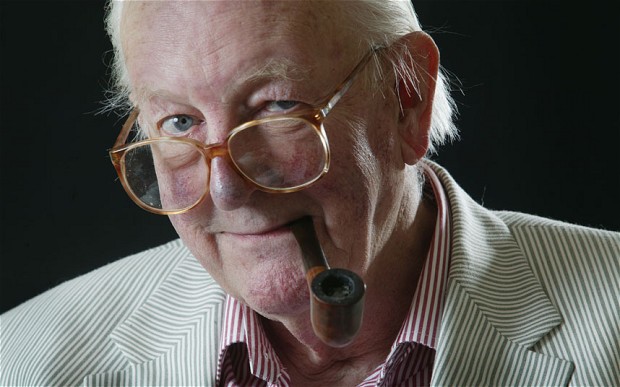
Tom Sharpe: an Appreciation


The British novelist Tom Sharpe, who died this in Spain this month, was one of the funniest writers I have read.

I remember reading on the dust jacket of one of Sharpe’s novels a comment by a critic which described Sharpe as ‘Wodehouse on acid’. Presumably the comment was meant to be a compliment. (The epithet, I feel, more aptly describes Joseph Connolly, another superb British comic writer.)

Tom Sharpe himself was known to be passionate about PG Wodehouse. While I have thoroughly enjoyed reading both the novelists, I’d, without hesitation, rate Sharpe higher than Wodehouse. Both have been described as quintessential comic British novelists. There are similarities in that the protagonists in the novels of both Sharpe and Wodehouse get themselves into improbably ludicrous situations (and equally improbably get out of them); both Wodehouse and Sharpe had a great eye for the absurdities in our daily lives and for our foibles which they both brought into sharp focus in styles which were unique. However, Sharpe wasn't just a comic writer, he was a great satirist.  I always related more to Tom Sharpe’s novels, probably because they occurred in a time frame which was more contemporary (I could always relate more easily to Sharpe’s hapless lecturer teaching in a polytechnic in the Fens and getting into all sorts of scrapes than the upper class toff—endearingly foolish as he was—in Wodehouse’s novels who was occupied full time in staving off amorous advances of rich totties with a penchant for going on moonlit walks and murmuring  sweet nothings). Both Wodehouse and Sharpe had a greatly developed sense of the ridiculous, which they embellished with exaggeration. Sharpe’s approach was more bawdy and his language was full of muscle. The scenarios against which the actions in some of Sharpe’s novels take place are very extravagant.

Many of Sharpe’s novels, while they differ in terms of the plots and settings, follow a set pattern. There is always at least one character (often more) that does not concern itself excessively about the niceties, has no scruples, and treats truth as a flexible concept that can be moulded to suit its current purpose. There is at least one gory and painful death that is sprung on the readers unexpectedly. The characters in Sharpe’s novels do not shy away from vulgarity—indeed they embrace vulgarity with open arms—and there is a fair smattering of swear words. There is a lot of sex, not all of which is pleasant. The story gathers momentum pretty quickly and proceeds at a frenzied speed. The protagonists (for example his Wilt novels) get into serious troubles including but not limited to accusations of murder and financial fraud, to name but two. The novels manage to be surreal, creepy, outrageous, indecent, egregious, and side-splittingly funny at the same time. Some of his novels make a serious point (which Wodehouse can never be accused off; a Wodehouse novel is a pure escapism).

Sharpe was a satirist of unparalleled skill and talent. His early novels, such as Riotous Assembly and Indecent Exposure, were savage satires on the policy of apartheid that prevailed in South Africa at the time. Both the novels were inspired by Sharpe’s experience in South Africa where he had lived for ten years (between 1951 and 1961) before he was deported for activities which the regime disapproved of. The novels in the Wilt series were satires—at times deliberately heavy handed, but, still, very, very entertaining—on the educations system in the British polytechnics, inspired, one suspected, partly by Sharpe’s own experience as a lecturer of History at the Cambridge College of Arts and Technology (later elevated to the status of university). 

In addition to his superb early novels Sharpe is perhaps most known for his Wilt novels. Wilt, like his creator, is a lecturer at a polytechnic (in Liberal studies), condemned to teach courses to bored butchers and plumbers, and lives with a wife who is no picnic to live with. In each of the novels Wilt unwittingly gets involved in bizarre disasters but survives with them with the skin of his teeth, not only because he is innocent but also because he is clever. Sharpe wrote five Wilt novels all of which, with the exception of the last, Wilt Inheritance (also Sharpe’s last novel), which I think is weak, are compelling reads.

Sharpe started writing relatively late. His first novel (Riotous Assembly), which was apparently written in less than three weeks, was published when he was in his forties. The publication of Riotous Assembly coincided with Sharpe’s decision to resign his job as a lecturer at the polytechnic in Cambridge, where he had taught for nine years after he was deported from South Africa (where he had worked as a photographer) for his open and vocal criticism of the Apartheid regime, and become a full time author. (I read in one of the obituaries that his publisher offered Sharpe £ 3000 for each of the three years in 1971, a not-inconsiderable sum in those days. The publisher must have had great faith in their hitherto unknown author, and Sharpe proved that their judgment was sound.) After the publication of Riotous Assembly Sharpe did not look back and published hugely popular novels at an enviable frequency. It was only in the last few years did his outcome dwindle. By that time he had grown very old and was plagued with health problems. It undoubtedly affected his last novels. The Gropes and Wilt Inheritance, Sharpe's last two novels, which came out in 2009 and 2010 respectively, were a disappointment. The storylines were limp; the bizarreness not quite of the level I had come to expect in a Tom Sharpe novel, and there were only glimpses of Sharpe’s trademark humour and mordant wit. I had wondered whether the great man’s powers were in decline.

In his long and distinguished writing career Tom Sharpe wrote several novels, of which I have read about a dozen. Below is a list of my top five Tom Sharpe novels.

Porterhouse Blue


My most favourite Sharpe novel, one of the funniest I have read, and one of the greatest comic novels of the twentieth century. The novel set in an academically mediocre fictional Cambridge college called Porterhouse, is a brilliant satire on the world of Oxbridge struggling to keep a balance between tradition and forces of modernity, and a hilarious sexual farce. The late Malcolm Bradbury adapted the novel for a television series in the 1980s.

Wilt on High


As I said earlier, with the exception of the last, all the novels in the Wilt series are hugely entertaining. Wilt on High, like its predecessor, is a reverberant black comedy with just the right admixture of the grotesque (unlike perhaps the later Wilt novels where the violence and sudden deaths tend to dominate.

Blott on the Landscape


This one of Sharpe’s early novels (also made into a television series starring David Suchet), a farce based on the conflict between urban development and its effect on the English countryside. The Blott in question is a German gardner ( a former prisoner of War) who works for an influential politician (Sir Giles Lynchwood) and his formidable wife, Lady Maud. The novel is uproariously funny with just enough luridity (Sir Gile’s fetishes) which were to become more pronounced in some of Sharpe’s later novels.

Throwback


This is another of my favourite Tom Sharpe novel, what I’d describe as a typical Tom Sharpe comedy. There are outlandish set pieces and more than adequate dose of sexual perversity. Although at times it tends to veer dangerously into bizarreness it does not go over the brink. The comedy is not for the fainthearted, though: dogs get drugged, taxidermists are employed to stuff dead grandfathers, and passages of sewage are reversed in insane plots to blow up houses.

Indecent Exposure


This is the second of Sharpe’s South African novels, a sparkling follow up to Riotous Assembly (also a must read). Underneath the laugh-out-aloud outrageousness, Sharpe makes a serious point about issues such as race segregation, police brutality (and stupidity) and also the British. Absolutely brilliant.

I do not think Tom Sharpe won any literary awards, which, I think, is more a reflection on the biases of the committees doling out literary awards towards what they view as genre novels. That however will not unduly concern the legions of Tom Sharp fans like me. He was one of the finest comic writers of his generation, who wrote novels that brought smiles to faces of people and made their dreary lives a bit more bearable. Of how many writers can we say this? May his soul rest in peace.

When Sharpe died Daily Telegraph published ‘Ten great Tom Sharpe Quotes’. 

Below is my list of ten great Tom Sharpe quotes.
  1. She is a painter. She paints with equal ardour and passion, though, perhaps less equal zeal. (Wilt in Nowhere)
  2. The plumbing system of the hotel might have held some fascination for an industrial archaeologist, but it kept me awake whole night (Blott on the Landscape)
  3. He is a nincompoop. One can only hope that he will, in due course, be promoted, carried forward by the ineluctable wave of inefficiency and the need to save the public the practical consequences of his latest idea, until he reaches that rarefied zone of administration, where, thanks to the inertia of his subordinates, his projects could never be implemented. (Blott on the Landscape) 
  4. I find his delicate contempt monstrous; there is an insufferable arrogance that views you as if you have been a microbe squirming convulsively upon a slide. (Porterhouse Blue) 
  5. His lack of scholarship is natural and unforced. She, on the other hand, probably possessed a mind and it has only been by most rigorous discipline that she has suppressed her academic leanings. (Porterhouse Blue)
  6. Not many people like or understand him. He is, like the British, an acquired taste. (Granchester Grind) 
  7. He is worse than an anachronism, more than an archaism. He is decadent, possesses a diseased arrogance to hide his abysmal banality and lack of academic distinction, and to hide from the outside world the fact that he is morally as well as intellectually bankrupt. (Granchester Grind) 
  8. He is a bloody word-merchant, a verbal contortionist, a logic-chopper, a linguistic Houdini, an encyclopedia of unwarranted information. (Wilt)
  9. He is as crooked as a second-hand car-dealer who ever welded two insurance write-offs into one single-owned Cavalier. (The Gropes)
  10. Guilt is often a substitute for good honest-to-goodness evil. (Riotous Assembly) 


Tuesday, 4 June 2013

Book of the Month: The Autobiography of Alice B Toklas (Gertrude Stein)


At the turn of the twentieth century, in Paris, a rich expatriate American secular Jewish family of two brothers and their youngest sister was making a reputation for itself as art collectors and patrons of upcoming artists, painters to be precise, who, the siblings were convinced, had great future.

The siblings obviously knew their onions. The painters they supported and whose paintings they acquired included Pablo Picasso and Henri Matisse. Other painters whose paintings they bought had either died (Cezanne) or were about to die (Henri Rousseau) in relative obscurity, but who, in the subsequent decades following their deaths, would be hailed as masters.

The family was the Steins—the brothers were Michael, the eldest of five siblings, who, in the 1890s, following the deaths of their parents, had inherited the family business of streetcars and, with wise decisions, had made a fortune; one of his brothers, Leo; and a sister, the youngest of the siblings, Gertrude.

In 1903 Gertrude Stein, after abandoning a medical career at Johns Hopkins (she lasted two years), joined her brothers in France. She lived in France for the rest of her life, through two World Wars.

Gertrude Stein lived with her brother Leo at rue de Fleurus, while the other brother, Michael, with his charismatic wife Sarah, lived in the rue Madame. In the first decade of the twentieth century, Gertrude and Leo Stein went on to assemble the most impressive private modern gallery which quickly achieved a formidable reputation; the siblings were intimately linked with the avant-garde artistic movement in Paris. They quickly developed a wide-ranging social circle comprising mainly painters but also poets, and, on Saturdays, presided over gatherings which became famous. Gertrude Stein, who had the personality to match her massive frame, dominated these get-togethers. It was the ambition of many an upcoming artist to be invited to Gertrude Stein’s soirees. While paintings of Picasso dominated the pavilion of rue de Fleurus, Sarah, Michael Stein’s wife was an enthusiastic supporter of Henri Matisse, who, she never tired of telling people, was a genius.


Alice B Toklas was born in California into a comfortably bourgeois Jewish family. Her mother, of artistic temperament, arranged for Alice to have piano lessons in which she became fairly proficient and for a while toyed with the idea of pursuing a musical career. In 1907 San Francisco, where Toklas had lived all her life, was rocked by a massive earthquake. The earthquake brought Michael and Sarah Stein to San Francisco to assess the damage caused by the quake to their income-generating flats, which were supporting their artistic life in Paris. Sarah Stein brought with her paintings of Matisse, amongst them Portrait A la Raie Verte, the first Matisse paintings to cross the Atlantics. The Steins and Toklases were family friends. During their meeting Alice B Toklas saw Portrait A la Raie Verte and was captivated. Sarah Stein, upon learning that Alice wished to visit Europe one day with her childhood friend Harriet Levy (who wrote her own memoir, 920 O’Farrell Street), urged Toklas to return to Paris with them. It didn’t quite materialize at that time; however, a few months later, in September 1907, Alice B Toklas arrived in Paris. Within a week of her arrival Toklas visited Michael and Sarah Stein. With them was Gertrude Stein. More than fifty years after this first meeting, more than a decade after Gertrude Stein’s death, and three years before the end of her own long life, in her autobiography (not to be confused with the book reviewed in this post), Toklas wrote:

 ‘It was Gertrude Stein who held my complete attention, as she did for all the many years I knew her until her death, and all these empty ones since then.’

Soon Toklas moved into rue de Fleurus (much to the uneasiness of Leo Stein), Harriet Levy was dispatched back to America, and Stein and Toklas became partners. The relationship lasted for almost 40 years and ended with Stein’s death in 1946.

Gertrude Stain wasn’t just an art collector; she also fancied herself as a writer; and not just any old writer, but a pioneering modernist writer who was going to be hugely influential, a writer who was a true inheritor of the legacy of Henry James (under the tutelage of whose psychologist brother, William, she had tried ‘automatic writing’ while at the Radcliff in the 1890s). The problem was: no publisher was willing to publish Stein’s works, which were described variously as dense, incomprehensible and inaccessible. She managed to find a publisher for her Three Lives, but no one was willing to touch The Making of Americans, Stein’s epic novel of an American family (written in modernist style, in the continuous present tense and with repetitive phrases—needless to say I shall steer clear of it). After various unsuccessful attempts to have this novel published despite help offered by influential friends (Ford Madox Ford published excerpts from the novel, upon recommendation from Ernest Hemingway, in Transatlantic Review), Stein launched her own publishing firm—nominally owned by Alice B Toklas—the existence of which was devoted to publishing and promoting Stein’s work. Stein sold off one of her early Picasso paintings to fund the venture. The Plain Edition, as the publishing firm was called, limped on for a few years and published five of Stein’s works (including five hundred copies of The Making of Americans) which failed to lift Stein’s fortunes.

Stein was nearing sixty, largely unpublished, and, as a writer, not very well known outside the coterie of her friends and well-wishers. After the acrimonious split from her brother Leo just before the First World War (the cause of which was never made public although Leo was said to have been deeply disapproving both of Stein’s lesbian relationship with Toklas and her writing style), Stein’s decisions to back what she thought were great artists had not paid off. (Indeed, many still believe that Stein owes her fame as a patron of the avant-garde to the astute judgment of Leo.) She was a genius; she had no doubt about it. She had led an extraordinary life—she was sure of it—and had contributed to the development of modern art and literature. The wider public needed to know all this.

Stein told her partner Alice B Toklas to write her, Stein’s, biography. Toklas refused. Stein then proceeded to write it herself, and titled it, tongue firmly lodged in cheek (one imagines) The Autobiography of Alice B Toklas. Of course it wasn’t Toklas’s autobiography; it was Stein’s autobiography. Stein made this clear by (rightly) taking the credit of the autobiography.

The Autobiography of Alice B Toklas, apparently written in six weeks, gave Stein what she had always yearned for: literary celebrity. The book was a success upon its publication and remains the best known (and probably most accessible) work of Stein.

The ‘autobiography’ begins with Toklas’s life in San Francisco before she came to Paris, her arrival in Paris with Harriet Levy, and her first meeting with Stein. From then on Stein takes over. We learn of Stein’s life from before she arrived in Paris, through the pre-First World War years, and through the war to the early 1930s. The book gives a light-hearted, amusing account of artists who visit Stein or whom Stein visits. Pablo Picasso, Henri Mattise, Henri Rousseau, Georges Braque, Francis Picabia, Guillaume Apollinaire (the man who coined the term surrealism), Jean Cocteau, Andre and Alice Derain, Juan Gris, Francis Rose, Ramon Pichot, Sherwood Anderson, Ernest Hemmingway—they are all here. We also meet artists whose names lay buried under the sands of time: such as the painter and printmaker Marie Laurencin, one-time girlfriend of Apollinaire; Mildred Aldrich, the American journalist and writer (known these days, if at all, for her wartime letters, A Hillitop on the Marne) of whom Stein appears to have been especially fond; and the forgotten British novelist Hope Mirrilees. Fernande Oliver, Picasso’s first famous mistress and the only one to have known him intimately when he was an unknown, struggling artist is there too. Daniel-Henry Kahnweiler, the German art gallery owner who supported the cubists, makes a guest appearance. We learn that Stein was one of the first subscribers of the lending library started by Sylvia Beach who went on to open the original Shakespeare and Co, the legendary bookshop of English language books on the Left Bank. The American millionairess Mable Dodge, whose ‘portrait’ Stein wrote and which Dodge published privately and tastefully, makes a cameo appearance. It is a list of Who’s Who in art in the first quarter of twentieth century.

The book has a gossipy, anecdotal feel to it. While telling an anecdote Stein jumps several years in time on a related topic; then goes back in time, before returning to the time of the anecdote which she begins telling. Thus, Guillaume Apollinaire, who died just after the First World War might make an appearance when Stein is narrating an incident that took place is, say, 1926, without any reference to time frame. It gets a tad confusing with regard to chronology. But it doesn’t matter: the inherent energy and insouciance of the narrative carries you through; you go with the flow and enjoy the ride. For example, the description of the party Picasso threw to celebrate a painting of Henry Rousseau is vivid and full of verve.

There are not many personal anecdotes involving these personalities, which stand out (except perhaps those of the mercurial Fernade Oliver); all the great names mentioned in the book seem to treat Stein like a precocious teenager who is overbearing, probably insufferable, but perhaps also a genius. Stein has absolutely no doubt in her mind that she is a genius. With un-selfconsciousness that is so endearing it brings a smile to your face she informs the reader that she wrote poetry that has ‘so greatly influenced the younger generation’. The opera she wrote on Saint Theresa of Avila and Ignatius Loyola (which Virgil Thompson, another admirer of Stein, set to music) was ‘completely interesting both as to words and music’. She is the true successor of Henry James; rather Henry James is Stein’s forerunner. Stein is one of the few who has created the literary methods of the twentieth century. For someone who, until then, was virtually unknown and whose gargantuan novel (The Making of Americans, which gets a mention on every other page in the first half of the book) was rejected by practically every publisher, the self-confidence is astonishing. Stein is also a woman of cut and dry opinions. She does not believe that writers can be proficient in more than one language, and declares: ‘one can only have one metier as one can only have one language. Her [Stein’s] metier is writing and her language is English.’ ‘The African’, according to Stein, is ‘not primitive; he has a very ancient and a very narrow culture and there it remains. Consequently nothing does or can happen.’ At one stage ‘Alice B Toklas’ declares that she has met only three geniuses in her life: Picasso, Whitehead and Stein. Stein is clearly a woman who sees a genius every time she looks into a mirror. (To be fair, when Alice B Toklas finally decided to write her autobiography—thirty years after Stein published The Autobiography of Alice B Toklas—she confirmed that Stein was one of the three geniuses she met in her life.)


On the front of the book is the portrait of Stein by Picasso. When someone commented that Stein in real life did not look like Picasso's painting, Picasso replied, "She will."

The Autobiography of Alice B Toklas is Stein’s autobiography, but not a great deal of information is provided about the life of Stein and Toklas; what we get instead is a near-continuous cavalcade of luminaries with whom Stein socialises. Stein and Toklas were lesbian partners, but not so much as a glimpse is provided into their daily lives. After reading The Autobiography of Alice B Toklas you’d be excused for thinking that all that the two women did every day of the week, every week of the year, year in year out, was hold soirees, visit rich friends, and go on holidays to Spain. Not a word is said about Stein’s acrimonious split with Leo Stein who went on to live in Florence after the split and died a year after Stein’s death; the brother and sister did not exchange a word for more than three decades. In her ‘real’ autobiography (What is Remembered) Alice B Toklas described the split in one sentence: ‘When he [Leo Stein] and Gertrude Stein disagreed about Picasso’s pictures and her writing [so not over Stein’s relationship with Toklas] he became unreasonable and unbearable. (Leo Stein, according to WikiPedia, described The Autobiography of Alice B Toklas as a ‘farrago of lies’.) The other brother, Michael, who was instrumental in bringing first Stein and then Toklas to Paris and who must have funded Stein’s cosy lifestyle (one does wonder while reading the book how Stein, who never worked and whose books didn’t sell, was able to afford it all) is completely ignored after the first chapter. Michael Stein lived in Paris until 1935 before he moved back to America with his wife; their son, Allan (immortalized by Picasso in a 1908 painting) who continued to live in Paris, was approached by Toklas for help in Stein’s last illness.

The Autobiography of Alice B Toklas came out in 1933. Stein could not have known what was in store for her in future. What was in store for her was the Second World War and the occupation of France by the Germany. It is way beyond the scope of this post to write about Stein’s conduct during the occupation years or her relationship with the Vichy regime. Stein and Toklas, both Jews, survived the occupation as did their treasure of paintings. This was possible because of Stein’s friendship with a right wing historian Bernard Fay who protected Stein (even as several thousand Jews marched to their death) during the Nazi occupation of France. (In her autobiography, which came out in 1963, four years before her death, Alice B Toklas—no doubt driven by the desire to protect the reputation of her dead partner—chose to completely gloss over Stein’s Faustian bargain or Fay’s role in saving her skin. Bernard Fay gets a very warm mention in The Autobiography of Alice B Toklas. He is a ‘dear friend’. As subsequent events showed he was also a loyal friend.)


It is a life, you get the impression, steeped in art. As you finish this witty, amusing and agreeably diverting account of an artist’s life in the first half of the twentieth century who was a close witness of the modern art movement, what stays in your mind is Stein’s larger than life personality. Gertrude Stein, in all probabilities, was not the genius she was convinced she was, but this is an eminently readable book.


Sunday, 12 May 2013

Tittooing: A New Cultural Phenomenon


I may be accused of many things, but I can say with complete confidence that I can never be accused of being a person of broad culture. I wouldn’t recognise culture if it jumped on me in a dark alley and bit me in the ass. When I was growing up the only contact I had with culture was at the bottom of the tub of rancid yoghurt. Some years ago I heard the Pulitzer award winner Junot Diaz (he was, at that time, several months away from his Pulitzer triumph) in a literary programme. Diaz recounted the story of his first generation, Dominican father, who, upon learning that his third born had published a collection of short stories and intended to make a career as a writer, asked him with genuine concern whether he was gay. I have the satisfaction of knowing that while I drove my progenitors to distraction over many things I never gave them a cause for concern about my sexuality (come to think of it I have never asked my parents their position—so to speak—on homosexuality) probably because I showed no inclination (because I had no talent) towards pursuing a literary profession.

What is a culture, anyway?  When I looked up the definition of culture on the Net, several popped up. The definitions could be broadly divided into two categories. A culture can be understood as patterns, behaviours, traits, belief systems, and predominant attitudes that characterize a particular period or society. Or you may define culture as any activity that can be construed as artistic or intellectual or both.

Within a culture there may be subcultures, if one follows the first definition of culture given above. Thus there may be patterns of behaviours and attitudes specific to communities or geographical areas within a culture, which may not be shared by other communities or areas. It may be perfectly acceptable in New Castle to squat by the roadside on a Friday night, outside a kebab shop, on your way to the fourth dance club of the evening (after you’ve been thrown out by the third dance club in a row for being disruptive and foul-mouthed) and urinate, stuffing the donar kebab down your cleavage (or in your mouth, if you are snobbish about hygiene), but the class-enemies in Chelsea may look down on this practice.

Keeping in mind the above, how can one attempt to understand the nipple tattooing that is allegedly spreading faster than Foot and Mouth Disease in Liverpool, England, if the reports in some British newspapers are to be believed?

Apparently women in Liverpool are craving for perfect nipples. Their idea of perfect nipples (apparently) is that the nipples should not only be of perfect shape but should also be darker in colour. This suggests that the alleged women allegedly living in Liverpool (allegedly in Britain) and allegedly craving for allegedly darker nipples are white. According to a report published in the world renowned British scientific journal, Daily Mail, it’s not just the nipples but the surrounding skin, called areola, that is reconstructed in this procedure (called areola reconstruction), which, the journal advises its readers, should be performed only by medical tattooist rather than the geezer in your local tattoo parlour who will not have the higher qualifications required before you are allowed to mess with women’s (or for that matter anybody’s) nipples. The procedure can be painful in more ways than one. Apparently the areola skin is more sensitive than the surrounding breast skin and without adequate local anaesthesia (which, I guess, would involve, by necessity, a sharp needle being inserted into the areola (ouch!), but after that everything will go numb) can be more painful than the chopping off the foreskin of your todger. And the cost! Don’t even ask how much it costs. An arm and a leg do not even come into it; we are talking about quadriplegic damage here.

When I read that Liverpudian women were more into nipple tattooing, also called (predictably enough) tittooing, than Tom Cruise was into Katie Holmes (before he went off her), I didn’t know what to feel. Should I be glad that they have found a less harmful way of mutilating their bodies than injecting gear? Should I be in despair that just when you think standards couldn’t get any lower in this country Liverpool proves you (yet again) wrong? Should I be happy that women (so far only in Liverpool, though Essex is likely to follow suit according to rumours) have declared that they are in charge of their nipples and will do to them what they wish? Should I be amazed that piss-poor Liverpudians have got thousands of pounds to spend on restructuring their nipples when half of the city is on dole? Should I be sceptical about the veracityof the report concocted by a trainee reporter, who probably decided (with good reason) that a sensational, titillating report would be her ticket to fame? Should I be outraged on behalf of the Liverpudians that such malicious media reports maliciously add to the malicious stereotype of Liverpool birds as a-little-bit-slutty-and-little-bit-nutty, ridiculous, over the top, tits-bigger-than-brains creatures with less sense of aesthetic than a Jehovah Witness’s understanding of human evolution? Should I give a flying f**k what these women in Liverpool, who obviously have more time on their hands than they know what to do with it, get up to?

Assuming that there are some reported cases (though not amounting to a pandemic) in, let’s say for the sake of argument, Liverpool (although there is no reason to assume that women in Islington wouldn’t want to inject local anaesthetics into their areolas), why might they want to change the shape and colour of their nipples? The obvious answer is that for the same reason some people want to change the shapes of their noses, eyebrows, breasts or the length (usually an increase) of their cocks (applicable only to men). They are not happy with what God has given them. 

But why nipples? How is changing the appearance of the part of your anatomy which remains covered for the best part of your waking (and in most cases sleeping) hours (unless you are a nudist or like to sleep in the nude) going to make a difference? But this, I suppose, is not how people beyond your or my way of reasoning think.

The scientific journal Daily Mail attempts to throw some light on the matter in its case report. The Mail reports the case of one Claire Jagger (who happens to be from Liverpool, although she could be from anywhere). Claire is 38. Is that important? Probably not, although the term ‘midlife crisis arriving early’ comes to mind. 38 years old Claire Jagger, according to Daily Mail, has had her jugs upgraded. But Claire did not stop at just a boob job. “My nipples,” Claire Jagger told Daily Mail, “were quite fair in colour, no different from any ordinary girl.” But Claire wanted to enhance them. How? By making them darker. And now Claire Jagger feels great because “I have absolutely perfect nipples.”  So here we have, Claire, an ordinary Scouser (allegedly) with ordinary nipples (self-report) and (presumably) less than ordinary tits (hence the boob job), who wanted to be less ordinary and decided that she was going to change the size, shape and colour of her nipples in her quest to achieve anatomical perfection and become less ordinary. It was, she readily admitted, the finishing touch to her boob job.

Daily Mail gives another example. Michelle, a 32 year old Liverpudian and mother of a two-year old, had her nipples done to make them bigger and darker. Her nipples, she helpfully informed, were “very small and made her feel childlike”. As Michelle grew so did her breasts, but—alas!— not her nipples. And, to compound Michelle’s misery, “they didn’t have rings”, which made them look wrong (apparently). What Michelle wanted were nipples the size you could hang your coat on; what she got, instead, were nipples smaller than a processed pea. She might have accepted her less than perfect nipples, with deep expressions of regret, as her fate, if she were, say, from one of the horrific Third World countries where women are shamefully repressed by medieval cultures which expect people to accept their bodily foibles just because they are born with them. But not in Liverpool, I shall thank you to keep in mind. In Liverpool Michelle has the choice of changing the colour and shape of her nipples if she is not happy with them. The result? She is happy, as is her partner. Michelle can now go swimming without feeling self-conscious that her nipples might be showing through her bikini (please note: Michelle was not self-conscious about her nipples showing through her bikini top, she was self conscious about her small nipples showing through her bikini); she can (for the same reason) take her bra off in front of her partner without feeling self-conscious. Their relationship is “so much better”, which is probably a codeword for their improved sex life. (“Darling, you look lovely and desirable tonight,” Michelle’s partner might say as he sucks back the saliva dripping from his mouth on to Michelle’s magnificent nipples pointing to the left and right; or, if the sight of the large, dark nipples sends him into an ultra-romantic mood, he might get poetic. If he is a reader of Joseph Connolly novels (although, seeing as the partner is from Liverpool, it is more than likely that his literary appetites are whetted by Nuts), he might break into a song, going something like “Roses are red, violets are blue—turn over darling ‘cos I’m going to do you”; but I doubt it. More likely, he tugs with his eager hands at those oh-God-are-they-for-real tits, moving them this way and that, as if granted free access to the control panel of Starship Enterprise, the only precaution he having to take is to shift his head out of the way in time so that the central knobs on each side do not take his eye out).  Michelle says she feels more outgoing, and more self-confident. Everyone is happy. 

I once read that people who owned Apple i-phones felt happier, more satisfied and contented. 
Perhaps someone should do a case-control study of happiness amongst Liverpudian women, comparing what Claire Jagger would describe as ‘ordinary women with ordinary nipples’ and those who used to be ‘ordinary women with ordinary, fair nipples but now are proud owners of larger and darker nipples’ for their  happiness quotient. Who knows? Nipple job may come to replace happy pills as a bona fide treatment for depression.

Are there any long term effects of the procedure? The British Journal Daily Mail cautions that there could be. An Aesthetic Plastic Surgeon (!) was quoted in the journal as advising women to consider how their nipples might look in the long term, because breasts change their appearance over time (who would have thought that?) Another revelation from the surgeon was that the “nipple-areola complex” changes with pregnancy, which, surely, will come as a shock to most. The women, therefore (the surgeon advised), would do well to think about their future. 

I would agree wholeheartedly with this. Years ago I used to go out with a woman who asked me how I would feel if she were to have a butterfly tattooed on her inner thigh. By that time I had had enough of her. She had large breasts but very pale nipples; but, honestly, that wasn’t the problem. The breasts bounced provocatively in her brassiere when she walked, but, disappointingly, didn’t retain their shape once she was horizontal, requiring to be scooped out from under her armpits, but, honestly, that wasn’t a problem either. The problem was—how shall I put this?— the woman didn’t want to be liberated from her emotions, wanting—demanding— that their existence (and importance) be confirmed (by me) frequently. I didn’t have problem with that per se, except that her emotions most of the time were about as pleasurable as a low-grade fever. In particular her tendency towards theatricality, accompanied by a pretension of underplaying her emotions, especially when she was pretending to be not hurt by some imaginary insult I didn’t remember hurling at her, was wearing me down. The woman was not easy to live with, no doubt about it; but I have to say that she wasn’t bothered about her nipples, which, if my memory serves me right, in addition to being very pale, didn’t have well defined borders and merged imperceptibly into the pallor of her soft, squishy breasts.  It wasn’t as if the woman didn’t have hang-ups; she was the kind of neurotic an analyst waits for all his life. Most mornings I would be woken up by theatrical sighs and confronted with the sight of her sitting up in bed and holding her soft stomach. Once she was sure that my sleep was ruined she would declare that she was becoming fat and look at me accusingly as if I was, somehow, to blamed for this calamitous state of affairs. It was impossible to say anything that did not offend her. If I agreed I was a shallow, superficial man who did not appreciate inner beauty; if I disagreed I was a liar; If I kept quiet I was indifferent and uncaring; if I told her it didn’t matter I was patronising; if I asked her what she expected me to say I was an emotional retard. But even this woman, who was a living, breathing museum of neuroticism, didn’t complain about her nipples. Thinking back would I have—not that I had any say in the matter—liked her nipples to be darker? Not really. Dark nipples would have looked very odd against the backdrop of pasty white flesh. There is an old Eddie Murphy film in which he is a prince in an African principality, and, as per the custom in the imaginary principality, needs to be bathed by semi-naked African beauties, all of whom have perfect small, chocolate brown nipples, exactly the right size for the stupendous breasts from the exact centre of which they wink at you. You couldn’t imagine these women with pale, pink nipples; they simply wouldn’t have matched their perfect mahogany breasts.  By the same token very dark nipples against the white skin would somehow look out of place, from the aesthetic point of view. Anyway my ex-girlfriend wanted to know my views about the butterfly tattoo on her inner thigh, which she hadn’t yet made. I reminded her (like the Aesthetic plastic surgeon) that she should think of future; she did not want the butterfly, in fullness of time, to become a moth flying out of a purse. We split up soon after.

Back to the original question: the alleged rampant tittooing in Liverpool: is it just a fad amongst a handful of probably not very bright women in Liverpool (so very stupid in comparison with the rest of the country)? Is it a feminist statement of sort (women choosing what they want to do to their anatomy)? Or—is this a possibility?—is Liverpool at the vanguard of a movement that might become an important strand in British culture?

Once I heard, at the Speaker’s Corner in Hyde park, London, a man wearing a skull-cap and a very bushy beard, shouting, his spit flying in every which direction, that Britain was a culture of homosexuals, paedophiles, other sexual deviants, degenerates, capitalists, imperial aggressors, blood-sucking insects, hypocrites, hooligans, rogues, scoundrels, damned  racists, and xenophobes. He prayed every day that the all merciful Allah struck him dead there and then because he did not want to breathe the polluted air of this infidel country where women did not wear a hijab, people indulged in shameless carnal activities strictly forbidden by the Quran, and where every last man was surely going to end up in hell for not following the path shown by Muhammad (peace be upon him). 

I wonder whether this man, in all probabilities still condemned to breathe the air of this kafr country unless the merciful Allah has granted him his fervent wish (he cannot be deported back to his country of origin, where he is bound to be tortured by the ruthless regime because he is a freedom fighter), has read the Daily Mail (not very likely). If he has, he would have no trouble, I suspect, adding tittooing to the list of behaviour characteristics and traits he so eloquently described that afternoon in Hyde Park, which distinguish what he understands to be British culture.  


Thursday, 2 May 2013

Book of the Month: Sleeping Arrangements (Laura Shaine Cunningham)


‘I began my life waiting for him. When other children asked, “Where is your father?” I had my mother’s answer: “He is fighting in the war.”’ 

Thus starts Laura Shaine Cunningham’s memoir, Sleeping Arrangements.  Shaine Cunningham never knew who her father was. Her mother, Rosie, had told her that her father was a handsome blonde fighter pilot, and his name was Larry Moore. He was fighting in the Second World War, and Laura, or Lily as she was called, was waiting for the war to be over, so that she could at last reunite with him. Until then there was only a black and white, overexposed photograph, taken in an army office, of him and his mother—Lily’s mother would hide it and rotate its hiding place every night—that was the proof that he existed. The trouble was the war was long since over, and Larry was not coming back.  By instinct, young Lily learnt to lie, as the fabric of her mother’s story began to fray, even though she did not (and would never) know the truth.

Lily’s first conscious memories are of her and her mother leading an evanescent, shadowy existence, in the living rooms and kitchens of various relatives, before they move into their own apartment in Bronx, in a building called AnaMor Towers. This building would be her home for the next decade, and it would be a witness to the vicissitudes in young Lily’s life. Lily soon becomes a latch-key kid, learning to cook and keep dinner ready for her mother, before she returns from work, from the age of five. She is also running wild with a couple of neighbourhood girls: Diana, a Catholic, and Susan, who, like Lily, is Jewish. Lily plays truant from school in Diana’s company and worships pagan Gods; and, in the bedroom of Susan’s parents, she plays elaborate sex-games, which these days would get social workers knocking on your door. Then Rosie dies after a brief illness that turns out to be cancer. Lily is eight, and the large extended family—Rosie is one of many siblings—gathers to decide what is to become of the orphaned child. It is expected that her uncle ‘Norm’, who is married and issueless, would take on the responsibility. But ‘Norm’ and his shiksa wife, who live down South, neatly side-step the subject and leave without Lily. It is left to her two bachelor uncles, Gabe and Lane, to raise their niece who never knew her father and now has lost her mother.

Uncles Gabe and Len move into their dead sister’s rented apartment.

What follows is a bitter-sweet, at times comic, at times sad, but ultimately life-affirming tale of how these two bachelors, with absolutely no child-rearing experience, bring up their niece, who grows into, belying the Cassandric predictions of their neighbours, a well-rounded young woman.

Sleeping Arrangements is a coming of age story of a parentless young girl in the 1950s’ Bronx. Shain Cunningham looks back with warmth and affection on the eight years she spent with her two uncles, who gave up their bachelor- lifestyles and took up the challenge of looking after their parentless niece. Although it is not spelled out explicitly, both the uncles give up their own accommodations, and the autonomy that goes with them, and move into the apartment little Lilly has lived in, so that the girl can have a sense of continuity—school, friends, ambiance—in her life. This means that each of them has to make a two hour journey to reach their work-places. They also take turns in returning to the apartment during Lily’s lunch hour—so that on alternate days it is a four hour journey for them—to give her company. At home the two uncles divide the household chores between them. Lane cooks while Gabe cleans. Hard as they try, the two bachelors have very little clue about housekeeping. Uncle Len is the more eccentric of the two, and does not believe in always towing the conventional line (he is also probably not a very good cook); he adheres to no timetable, and serves pop corns or hamburgers for breakfast. He also insists on wearing his ‘uniform’ while cooking: a pith helmet and an apron.  Soon he earns the sobriquet of ‘The King of Pressure Cooker’. The other uncle, Geb, declares war against dirt and attacks grime, a mop and pail in hand, with an enthusiasm that borders on violence. The trouble is Gabe is as clueless about cleaning and the functions of everyday cleaning products as his brother is about cooking, and uses bathroom scouring powder to clean the wooden floor in their living room. The brothers’ solution to the laundry problem is to send their clothes to a professional laundry which sends back the clothes fiercely compressed and full of creases.

‘Uncle Len’ is a private investigator. He is also a giant who wears size 13 shoes and, at six feet four, is a cross between Abraham Lincoln (he is convinced Lincoln had an undiagnosed medical condition that made him so tall) and Sam Spade. Uncle, Gabe, is a librarian. Both the uncles have literary inclinations. Uncle Len has academic ambitions and carries with him massive manuscripts on the Lincoln administration written from the Secretary of War Stanton’s point of view, his, Len’s, aim being to give the unsung hero, Stanton, his due credit. This is Len’s serious work. He also writes short stories ‘to make money’. His stories always include dashing men in trenchcoats who rescue damsels in distress from exotic locations. Uncle Len carries the secrecy that must have been required in his line of working to all aspects of his life. He writes at ‘another location’, which he never discloses. He has a steady girl-friend, with whom he spends most weekends—announcing, as he leaves, that he is going on a secret mission—but the lady is never invited to the apartment and Lily never actually meets her. He bestows an air of mystique and suspense to every day mundane tasks, whether out of habit or eccentricity or a wish to keep his little niece entertained, is not clear. He never raises his voice and is excessively formal in all his addresses. ‘Uncle Gabe’, the librarian, is a song writer in his spare time. A devout Jew, he writes gospel songs and attends shul very regularly. He is less secretive in his romantic liaisons than his brother, but none of them comes to fruition, probably, you suspect, because of his insistence on wrapping up the evenings by singing love songs he has written. He also has a dream of converting nonreligious women to his deep orthodox faith. ‘Uncle Len’ describes Gabe’s courting style as unrealistic.

This is without doubt an odd household. And it gets even odder when Lily’s grandmother—her uncles’ and her mother’s mother—comes to live with them. Her name is ‘Esther in Hebrew’, ‘Edna in English’, and ‘Etka in Russian’. She prefers the Russian name and refers to herself as ‘Etka from Minsk’. It soon dawns upon young Lily that ‘Etka from Minsk’ is, if not entirely out of her mind, not entirely within it either. She sings non-stop in Russian, Hebrew, and German; and chants tunelessly her own praise—she is the most beautiful, the most intelligent, and (above all) has the most perfect legs (she is eighty years old). And this is not her only idiosyncrasy. She insists on covering everything in black, and balances saucers on top of glasses. She goes through periods when she gets obsessed with ideas, and does not let go of them—once, in the grip of a mania for frugality, she cuts everything, including blankets, into half. She steals Lily’s clothes and other trinkets, and wears them herself, insisting that they are her own. ‘Arteriosclerosis’ is the word ‘uncle Len’ conspiratorially mutters into Lily’s ears to explain his mother’s very odd behaviour and habits. Lily realises that ‘Etka from Minsk’, in addition to being deaf in one ear, is also very forgetful. She seems to think at times that she is in a hotel, and does not appear to be aware that her daughter, Rosie, Lily’s mother, is dead. Rosie, according to Etka, got a promotion and is working in Washington. Soon Etka and Lily not only learn to tolerate each other, they also work out a scheme for peaceful co-existence. Lily’s part of the bargain is to edit Etka’s memoirs. Like her two sons—and, we learn later, her late husband—Etka too has literary ambitions, and she is not prepared to let go of them even in her senility. She is writing her memoirs, ‘The Philosophy for Women’, in which most sentences begin with the words ‘I believe’ and which are levered by the tenet, repeated throughout the memoirs (that fill more than hundred spiral pages of a notebook), that she was meant to do ‘brainwork’ and not ‘housework’. The ambition of Etka’s life is to get a college diploma—she has even composed a poem (‘A college diploma beats a lifetime of toil / For every boy and goil’) to express the high premium she puts on these certificates—, and when she attends the graduation ceremony of her son, ‘Uncle Len’—he has been quietly attending a Night School has earned his final credit for his master’s degree—she wants one too. The two brothers and their niece then prepare a fake diploma certificate, and, in a ceremony that seems too surreal to be true, they solemnly present to Etka the diploma certificate one evening in the local public garden, under a statue.

The ingenuity of the uncles is severely put to test as Lily reaches adolescence. Bound by the traditional etiquettes in these matters, common, no doubt, to men of their generation, both Len and Gabe are severely ill at ease in discussing what Len euphemistically refers to as ‘the facts of life’ with their niece. Since ‘Etka from Minsk’ proves to be of little use, they send for her younger sister, the great aunt Dora, whose strategy is to present Lily with a brassiere from the tsarist era and leave it to her to figure out the rest. Her uncles, in an act of utter desperation, slip a copy of ‘Facts of Love and Life for Teenagers’ under her pillow. In the end, Lily learns about ‘the facts of life’ in the same way as many teenagers from her generation: from her friends.

The unlikely happy family continues in this fashion for more than eight years, during which period hey change first apartments and, later, when Bronx becomes too violent, area. The family unit breaks when Lily leaves home to start University. We learn, in the Afterword, that the two brothers carried on looking after their ‘arteriosclerotic’ mother till she died at the great age of eighty eight. After that Uncle Gabe immigrated to Israel and promptly settled into matrimony, while Uncle Len retired to a Southern state; he continued to see his girl-friend of years, but the two did not marry. Shaine Cunningham tried to search for her absentee father off and on for a number of years without getting anywhere, before finally giving up the search. The memoir ends with Shaine Cunningham declaring that she is not his (her birth father’s) child; she is the child of her two uncles who raised her against convention.

Sleeping Arrangement is more than just another coming of age story. It is more than a memoir. It is an ode of love and gratitude to the two men who devoted the best years of their lives, and quietly and uncomplainingly sacrificed their personal interests in order to look after the daughter of their dead sister.  This is a vividly remembered childhood—the details provided of the fierce childhood games and associated activities with playmates are astonishing. Whether the events happened exactly the way they are recounted or whether an artistic license has been taken is beside the point. Shaine Cunningham has successfully portrayed the atmosphere, the ambiance, of the times she grew up in, both within and outside of her home. In simple, direct, and pellucid prose she intensifies the impact of all the things that went on to shape her childhood and, no doubt, contributed to the development of her emerging personality. When Lily begins to avoid school in her fifth grade because of her terror of the new class-teacher, Uncle Lane takes her on a ‘secret mission’ to an island. The island is Cuba, and Castro has usurped power only a few weeks ago. They spend a few days (in a deserted Five Star hotel) on the island that is still in the midst of a revolution. On their way back, Len says to her, ‘Now, doesn’t this give you a perspective on Mrs. Aventuro?’

The writing of Sleeping Arrangements  is very atmospheric. Such is the power of narration that you are instantly transported to Lily’s apartment in Bronx and ‘see’  ‘Uncle Lane’ trying out his recipes in the kitchenette, with a pith helmet on his head, uncle Gabe going over his gospel songs in the dinette, and Etka humming to herself in the bedroom window. This is an affectionate memoir, but at no time does Shaine Cunningham wallows in mawkish sentimentality. The personalities of her two generous-hearted uncles and eccentric grandmother—‘Etka from Minsk’ is one of the most memorable characters to have been depicted, both in fiction and non-fiction—come across very distinctly, as do their love and concern for orphaned niece. Against all odds and conventions they managed to be a happy family. And the warm glow of the felicity stays with you long after you come to its end.

Laura Shaine Cunningham is not a familiar name in Britain, but she is apparently well known in her native America as a writer and play-write of distinction. She has published another book of memoirs (A Place in the Country), several plays and a few novels. Sleeping Arrangements was published in the United States in 1989, and it took another sixteen years for it to be published in the United Kingdom. Judging from this enchanting, tender, warm-hearted, and very moving memoir her reputation ought to cross the Atlantic. 


Friday, 5 April 2013

Ruth Prawer Jhabvala


When Ruth Prawer Jhabvala died in New York in April 2013, The New York Times published her obituary under the heading: ‘Ruth Prawer Jhabvala, Screenwriter, Dies at 85’. Many other obituaries included photographs of Jhabvala along with Ismail Merchant (who died in 2005) and James Ivory, the producer director team with whom Jhabvala had a long, fruitful and acclaimed association, spanning several decades: Merchant was the producer, Ivory was the director, and Jhabvala was the screen writer. She wrote screenplays for more than 20 films for the Merchant Ivory production that saw her win the Oscar for the best screenplay twice. Many of the films were adapted from literary novels, some of Jhabvala and some of others. (She won the Oscars for her screenplays for the films based on the novels of E.M. Forster—A Room with A View and Howard’s End).  

One wonders what Jhabvala would have made of the obituaries; a fair number focused on her (admittedly considerable) achievements in films, which she described on more than one occasion as her hobby. (She listed script-writing as a ‘recreation’ in her Who’s Who.)


                                   Ismail Merchant, James Ivory & Ruth Prawer Jhabvala

Ruth Prawer jhabvala, without doubt, was a talented script-writer (even if she did not take it seriously); she was also an outstanding novelist. She wrote a dozen novels and several short-story collections. One of her novels won the Booker Prize, Britian’s highest literary award, in 1975.

Over the years, I have read several novels of Jhabvala, but, regrettably, not as many short-stories as I ought to have. I loved all the novels that  I read, and Jhabvala became  a very favourite author. 

Below are some of the Jhabvala novels I have loved:

Heat and Dust

This is easily one of my all-time favourite novels. It is a slim novel which slips in and out of the lives of two women—the unnamed narrator, and Olivia, the reprobate first wife of her grandfather, whose name is a taboo in the family circle, for the scandal she caused—who arrive in India, fifty years apart. In some ways it is a predictable, a-Westerner-goes-to-India-and-has a life-changing-experience novel. What makes it a winner for me is Jhabvala’s lucid prose style which manages to convey vividly for the reader the oppressive, claustrophobic climate of India, which affects you in ways you didn’t think possible. It is unsentimental, truthful and unputdownable. Heat and Dust won the 1975 Booker Prize (a strange scenario in which no long-list was announced, and the short-list consisted of only two novels). Heat and Dust was later made into a Merchant Ivory film for which Jhabvala wrote the screenplay.

The Householder

This is an early novel, first published in 1960. It was the catalyst for the long association between Jhabvala, Ismail Merchant and James Ivory. (I read in one of the obituaries that when Merchant and Ivory travelled to Delhi, where Jhabvala was living at the time, to persuade her to write the screenplay for the film they wanted to make based on the novel, so nervous was she that she pretended, upon first meeting them, that she was her mother-in-law!) This novel is a little gem, crackling with dry witticism and humorously perceptive. If Heat and Dust was an outsider’s view of India, The Householder is an insider’s perspective, and depicts for the reader, the pretensions and airs of the Indian middle classes (of the 1950s) in an entertaining, yet warm, manner. Wry and recondite, I will rate this novel on par with some of the highly comic early novels of V.S. Naipaul.

Esmond in India

This is another early novel of Jhabvala, and another comedy of manners that does not fail to delight. The story proceeds in a series of humorous vignettes. The novel is also an oblique commentary on the uneasy relationship between the Indians and the Britishers who ‘stayed on’ (after the title of the Paul Scott novel with a colonial theme, which went on to with the Booker Prize in 1977) in the newly independent India. The novel subtly, but very skilfully, highlights the contrasts in the life-styles of the new Indian elites and the former-ruling-elites. There are some highly amusing set-pieces in the novel, but there is also an underlying seriousness. This is a first-rate novel.

A Backward Place

This novel came out in the 1980s. By this time the wellspring of Jhabvala’s love for India, which couldn’t possibly have been more removed from the place of her birth, had dried out. She had left India, where she had lived for more than two decades, a few years earlier, and relocated to New York; but India, it seems, still haunted her. A Backward Place, which tells the story of Bal whose grand ideas and visions do not sit well with the life he lives with his jaded English wife, in India, has its comic moments, but there is an edge to the humour. Some of the scenes in the novel are very delicately nuanced. This is a novel, while comic in parts, has a darker theme. (I find a similar trend in the novels of V.S. Naipaul. His early novels brim with innocent humour and depict simple lives of simple folk; the themes begin to get very sombre in his later novels, most of which do not show a trace of humour. Many of Jhabvala's later novels have a melancholy strain to them, but, unlike Naipaul's later novels, they are not totally devoid of humour.) Jhabvala was German Jewish by birth and spent the majority of her life in India and  America, but the style of her writing, the chilling humour and witticism, very much on display in this novel, are very British, in my opinion.

In Search of Love and Beauty

This may be the only novel of Jhabvala that is not set in India. It has an American setting, New York to be precise, the city where Jhabvala came to live after she had had enough of India, and where she lived the longest. Like many of Jhabvala’s other novel,s the momentum of the story builds up gradually through a series of scenes and incidents. The theme, here, is of uprootedness (something which Jhabvala  carried with her at the core of her soul all her life; in an interview given to The Guardian a few years ago, she described herself as a refugee), thwarted lives and unfulfilled ambitions. As in A Backward Place, there is a brilliant juxtaposition of comedy and pathos.

My Nine Lives

This was the last published full-length novel  of Jhabvala, which came out in 2004. It had a subtitle: Chapters from a possible past, which suggested that the novel was autobiographical. This novel, which, I think, comes in the category of fictionalized memoir (a genre exploited expertly by the Nobel Laureate, J.M. Coetzee, in a series of books, starting with Boyhood, in the last ten years) is an utterly fascinating read. The story proceeds in a series of tales, told in nine chapters, through nine possible lives, which unfold on the backdrop of what might (or might not) be Jhabvala’s own past. In common with many of Jhabvala’s later books, the theme unifying these lives is of sorrow and loss of promise.

Going through the obituaries I learned that Jhabvala was born as Ruth Prawer to German Jewish parents in 1927, in Cologne, Germany. With the rise of the Nazis in Germany the family, throughout the 1930s, experienced harassment and discrimination. Her father was a solicitor and found it impossible to get work as the anti-Semitism grew. The father finally managed to persuade his wife to leave Germany in 1939; the Prawers were one of the last Jewish families allowed out of Germany. Ruth Prawer was 12 when she arrived in England along with her parents and older brother, and could not speak English. (She never went back to Germany or spoke German. Indeed she very rarely spoke about her childhood. Her brother, on the other hand, became a professor of German and European languages at Oxford.) The Prawers were the only ones to survive from the extended clan; the rest, numbering almost 40, perished in the Holocaust. Her father, when he finally discovered the fates of all his near and dear ones, committed suicide in 1948. In 1951, while studying English in London, Prawer met a young Indian architect, Cyrus Jhabvala. She married him and went with him to India, where she lived for the next 25 years. It was while she was in India, in the mid-1950s, that she began writing novels. Indeed, so accurate was her depiction of the Indian lives in her novels that many critics in India (so I read in one of the obituaries) thought that she was an Indian writer. Heat and Dust, for me her most complex and satisfying novel, which came out in 1975, was the last novel she wrote in India. By this time she was tiring of India. She had mixed, often contradictory, feelings towards the country which was her home for more than two decades, but which was now exhausting her. Her husband was Indian, and she accepted that her children were Indian; but she was a central European 'with a deplorable tendency to constant self-analysis'. (In their adult lives Jhabvala’s three daughters would settle in the three continents which, at various times, were Jhabvala’s homes: Europe (England), India, and America.) Her health was suffering, and she decided to move to New York. She would live in America for the remainder of her life. After she moved to America, Jhabvala and her husband (who stayed back in India because of his work commitments) had a long-distance relationship across the two continents for more than a decade. Jhabvala would spend several months every year in India while her husband took long vacations in America. After his retirement Cyrus Jhabvala, too, moved to America. I read in (a moving) obituary of Jhabvala in the Guardian that shortly before her death Jhabvala accepted a visit from a rabbi. After performing a blessing, the rabbi asked her what was the best thing she could recall in her life. One of her daughters wrote afterwards, “Without any hesitation she pointed to Pappa.”

Ruth Prawer Jhabvala was a brilliant writer. Her writing was witty, wry, funny, and distinct; her prose style was straightforward, yet evocative; and she had the knack of getting to the core of things with minimum of fuss. She wrote stories that were compelling, enjoyable and utterly credible. May her soul rest in peace. 


            Jhabvala with her daughters and director James Ivory in Mumbai in the 1960s